Click Play to begin
Alzheimers Disease continues to be our focus in this second installment on the subject. Another study was done in 2015 out of Italy where Aloe arborescens extract was employed in various experiments. As a reminder, Acemannan is the active ingredient in the aloe plant the researchers used. This study places on the table some very interesting data for further discussion. So let’s dig deeper and reach wider.
The study is entitled: Aloe arborescens Extract Protects IMR-32 Cells against Alzheimer Amyloid Beta Peptide via Inhibition of Radical Peroxide Production
The term arborescens means “becoming a tree” and it is just a botanical term to help further describe the botanical species of this aloe plant. We have another study at this website where this same terminology was used at this link:
This same study also referenced Acemannan as the active ingredient in the Aloe plant.
First, let me introduce you to beta-amyloid. Beta-amyloid is a toxic protein and it damages the brain in such as a way as to contribute significantly to Alzheimer’s Disease.
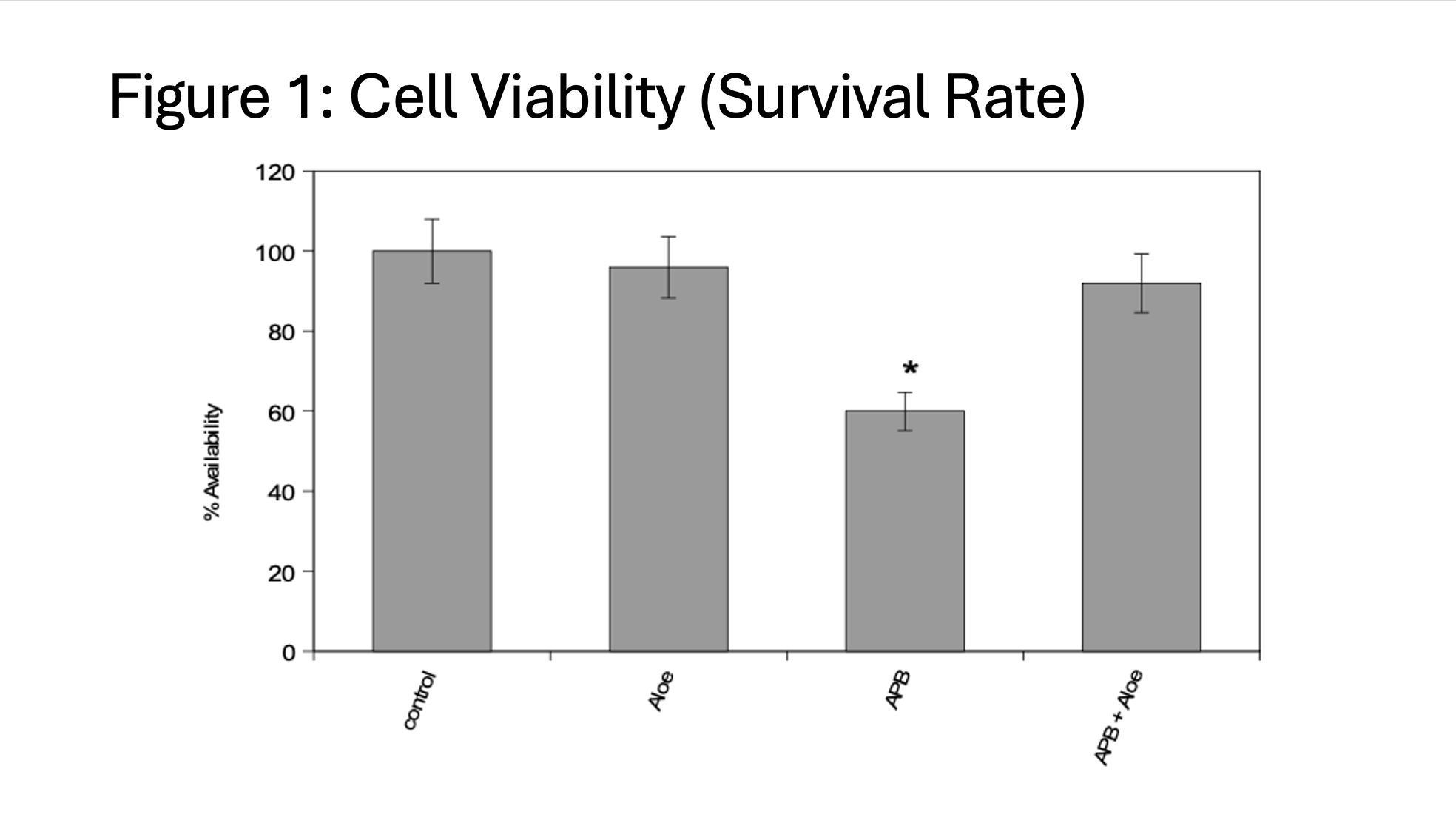
The scientists in this study utilized IMR32 neuroblastoma cells, which are human brain-like cells. They placed them in four different lab dishes. This graph explains what they did with each lab dish and what the results were: We are going to look at four
The first bar is the Control
- These are healthy brain cells that didn’t get any treatment at all.
- This group shows normal cell survival at 100%.
- As is always the case, The Control serves as the baseline for comparing all the other groups.
The second bar in the experiment they added Aloe (Acemannan) extract only to the healthy brain cells (no beta-amyloid). The cell survival stayed about the same as the control group. The conclusion here is that Aloe (Acemannan) by itself is not harmful or toxic to the cells. Of course, this is a conclusion we have to in other presentations.
The third bar they treated the healthy brain cells with Beta-amyloid only, which is the toxic protein. In the graphs you are about to see the abbreviation for Beta-Amyloid is APB. This is Amyloid Peptides Beta. But is commonly known as Beta-Amyloid. In this experiment cell survival dropped to about 40%, meaning 60% of the cells died. Conclusion and what is also common medical knowledge➜ Beta-amyloid is very damaging, just like in Alzheimer’s.
The fourth bar is where the cells were pre-treated with Aloe (Acemannan) extract, and then exposed to beta-amyloid. The results showed cell survival stayed close to normal levels, much higher than the Beta-amyloid-only group. Conclusion: Aloe (Acemannan) helped protect the cells from the damage typically caused by beta-amyloid.
Figure 1
But that’s not all.
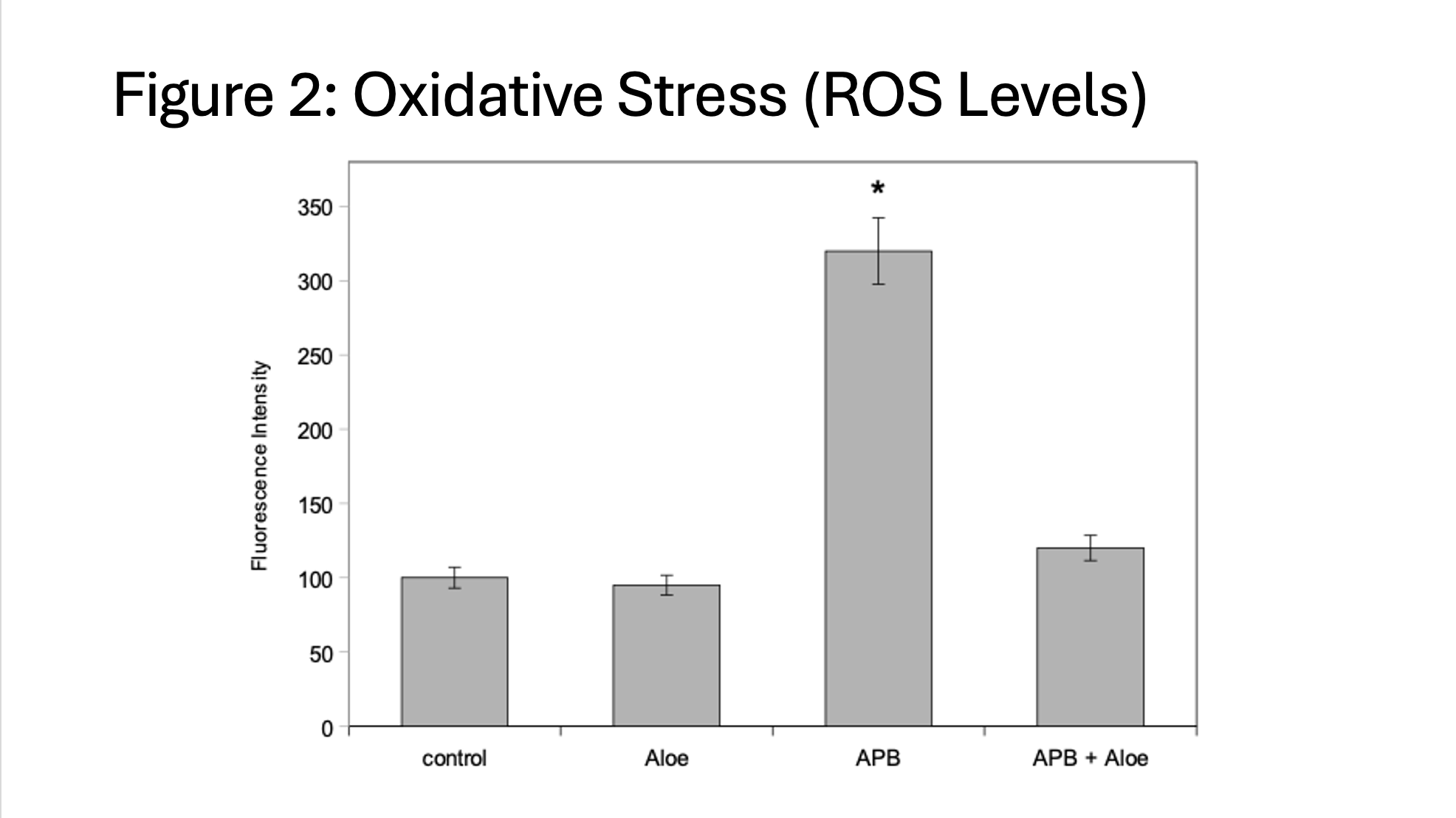
This graph represents a focus on Oxidative Stress. This chart shows how much ROS (Reactive Oxygen Species) the brain cells made. ROS are harmful molecules that build up during stress and then damage cells.
First, we have the Control experiment. Normal, healthy cells reflecting low ROS, a low oxidative stress.
The second experiment, is the Aloe (Acemannan) only. It did not increase ROS. Oxidative stress is still low.
Third, the Beta-amyloid was added to the healthy brain cells. Then the ROS levels shot up, showing lots of damage.
The fourth experiment , Cells pretreated with Aloe (Acemannan) had low ROS again, close to the control. Aloe (Acemannan) protected the cells from stress.
Takeaway: Aloe helped stop the harmful molecules (ROS) from building up even when beta-amyloid was present.
Figure 2
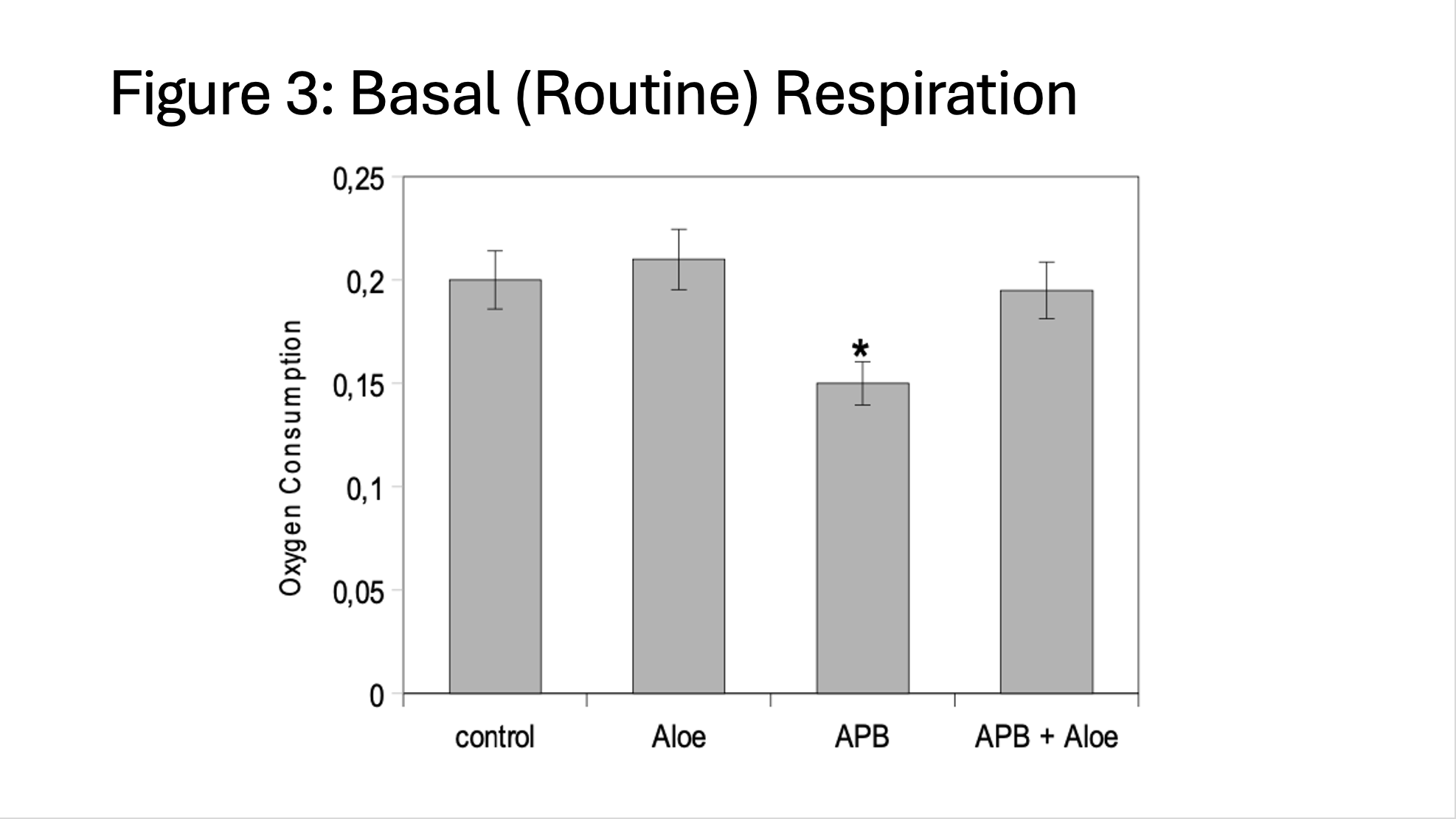
In the next experiment, they are testing for Basal (Routine) Respiration.
When using the word Basal, think routine. What Basal Respiration means is the basic level of energy production that a cell performs just to stay alive and do its normal everyday functions — like breathing, growing, and repairing itself. Its routine. Its the energy your body uses just to keep the lights on. It tells us how active the mitochondria are. The mitochondria are the cell’s power plants.
Basal Respiration might be likened to an Athlete at Rest
Imagine a professional runner: Even when they’re sitting on the bench or walking around slowly, their body is still: Breathing, Pumping blood, Keeping their muscles fueled, Managing body temperature
That constant, low-level activity is like basal respiration — the body’s basic energy use just to keep everything working in the background. Routine.
This graph shows how well cells were using oxygen under normal conditions (no added stress). It tells us how active the mitochondria were.
First is the Control experiment – Normal oxygen use here (healthy cell breathing).
Next is the Aloe only – Same as control. Aloe doesn’t mess with energy use.
Next is the Beta-amyloid (APB) –our toxic protein, this is where the Oxygen use dropped. The mitochondria were damaged.
And then the Aloe (Acemannan) + Beta-amyloid experiment– Oxygen use went back up. Aloe (Acemannan) helped keep energy levels normal despite the presence of the toxic beta-amyloid.
Takeaway: Aloe helped the mitochondria keep working even when beta-amyloid tried to damage them.
Figure 3
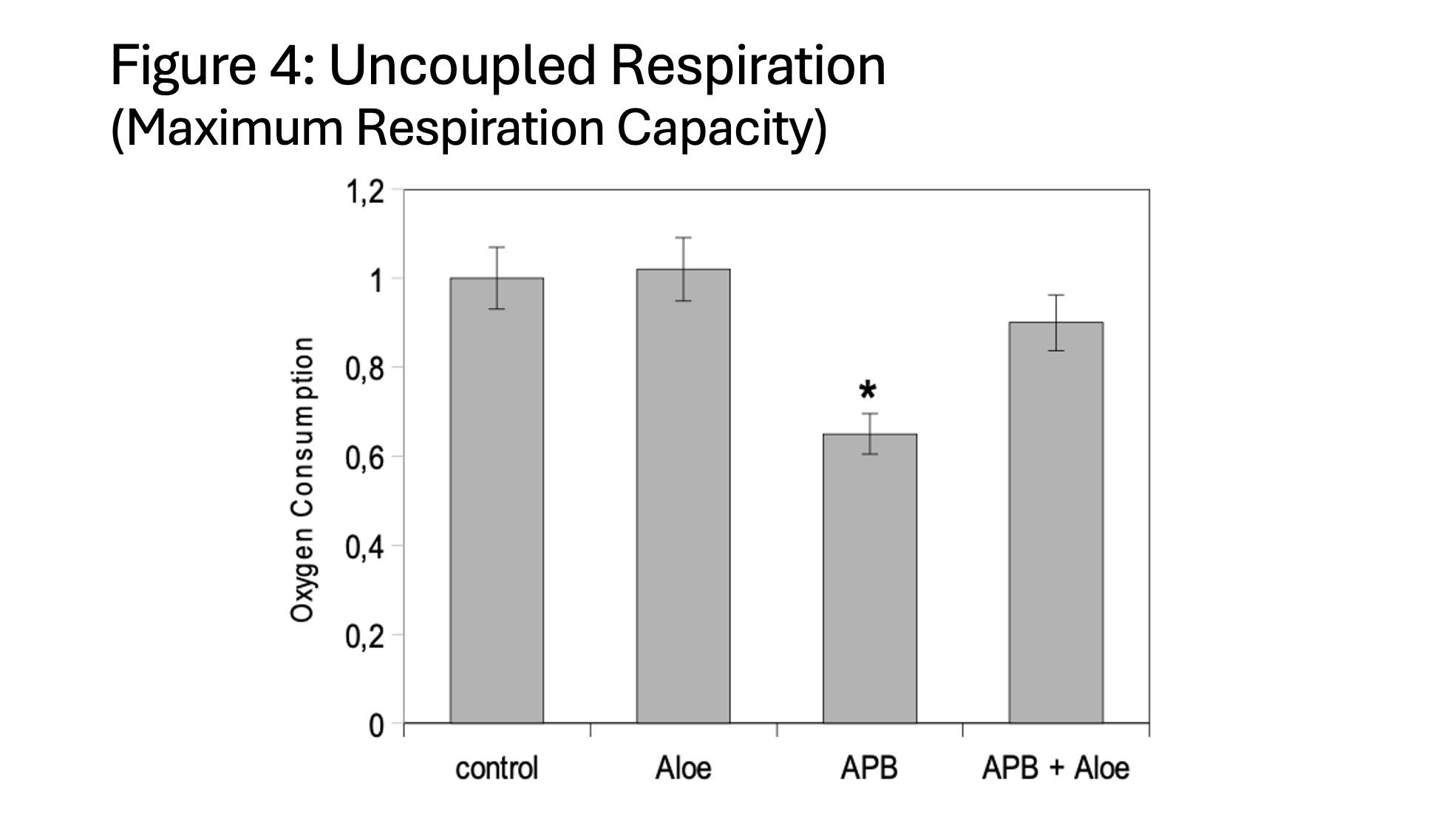
This graph called: Uncoupled Respiration (Maximum Energy Capacity). This test forces the mitochondria to work at full power, to see how much energy they can produce. Using the athlete metaphor above, imagine when the athlete goes into a Full Sprint with everything they’ve got, they’re breathing hard, needing more oxygen, burning tons of energy, pushing muscles to the limit. In a cell this is maximum respiration, when the cell’s mitochondria are making as much energy as possible. And must work harder for the needed oxygen to perform.
We have the Control model – Cells had strong energy output.
In the Aloe only – Similar power as the control experiment.
In the Beta-amyloid (APB) model– Mitochondria could not hit full power. Damaged.
And then finally the Aloe (Acemmannan) + Beta-amyloid – Energy output was better, close to normal.
Takeaway: Aloe helped restore the cell’s maximum energy-making ability.
Figure 4
Let’s go back to our athlete metaphor. At age 20 when he is in the greatest shape he is using energy to its highest capacity, but as time goes by, inefficiencies develop, especially as he ages (not unlike the age where Alzheimer’s might begin to set in many decades later). As a result, energy slowly leaks. The runner isn’t using that energy to do anything helpful. It’s just being wasted. That’s what leak respiration is like: extra energy your body has to use to deal with problems or damage inside the cell, a damage sometimes caused by the presence of beta-amyloid.
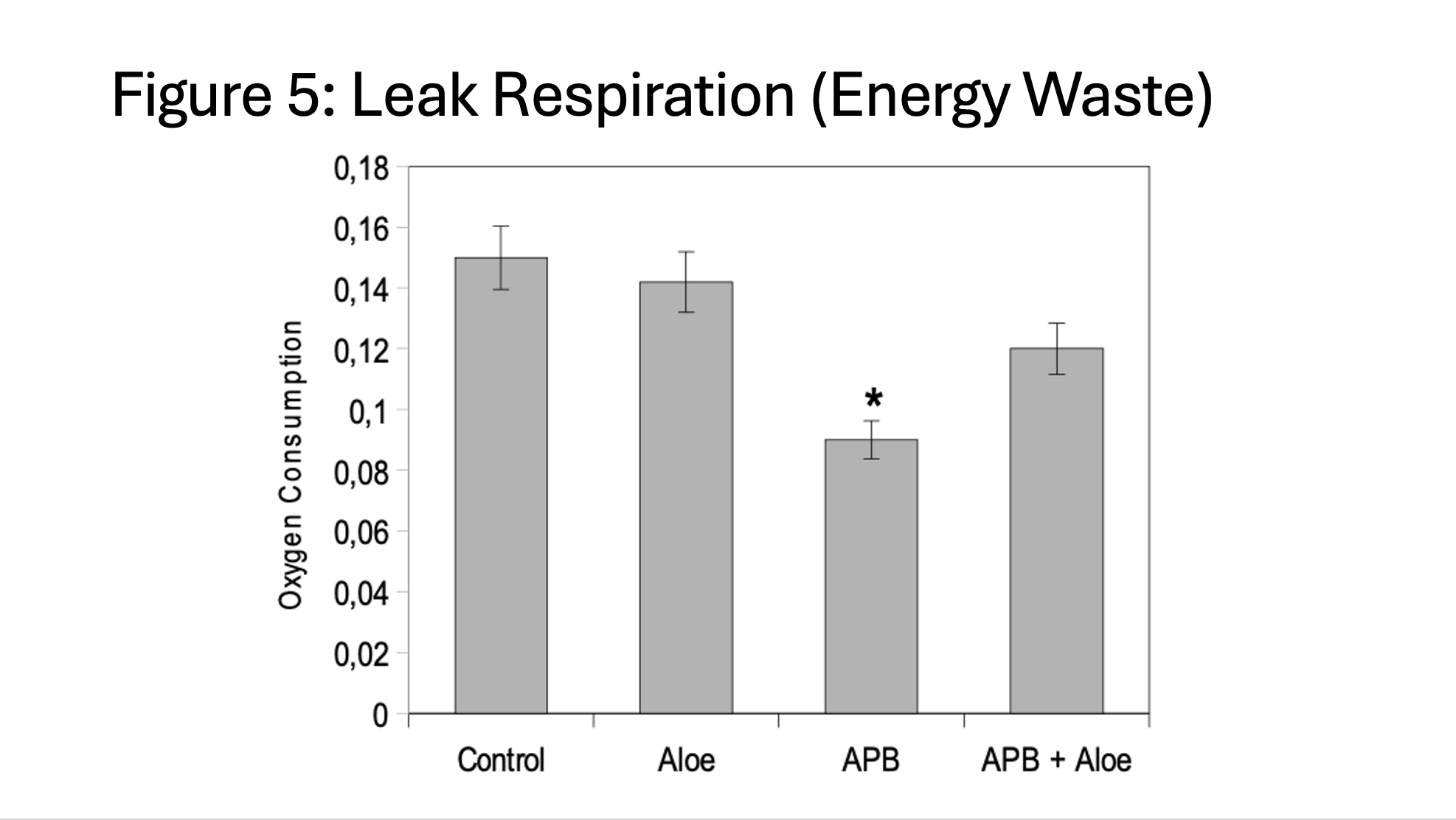
This graph represents Leak Respiration.
This test checks how much energy is being wasted (instead of being used to do work). Higher “leaks” can mean damaged mitochondria.
This bar is the Control experiment and has low leakage. Things are good.
The bar is Aloe (Acemannan). Leakage still low.
Then there is Beta-amyloid (APB) only group. We see leakage increased and energy is being lost.
Then we have Aloe (Acemannan) included with Beta-Amyloid and the leakage is reduced again. Acemannan made a contribution to system efficiency.
Takeaway: Aloe made the cells more energy-efficient, even under stress.
Figure 5
Maybe you have noticed that I made no explanation of how these experiments were performed but now it’s time. This table will give short explanation of what they measured, how they measured the results, and why it matters. So this will also serve as the means to summarize everything we have talked about so far.
In our first figure, what was measured was cell viability, the survival rate.
How did they do that?
They did it with what’s called an MTS assay, which changes color based on how many living cells were present.
Why it matters is that it shows just how toxic beta amyloid is to cells and how Aloe Acemannan helps protect them from dying.
In figure number two, they measured the oxidative stress, the ROS levels.
And how they did that, was to use a fluorescent dye that glows in the presence of ROS or reactive oxygen species.
Why it matters is that it shows how beta amyloid increases cell damage and how aloe Acemannan reduces that damage.
In figure three, what was measured was the basal respiration, the routine. They measured that by using a nutrient solution to measure oxygen consumption.
Why it matters?
It shows if mitochondria are still working normally, reflecting basic cell energy production.
Figure four, what they measured there was uncoupled respiration, also known as maximum respiration capacity.
How did they do that?
The oxygen consumption was measured by applying FCCP a chemical compound commonly used in laboratory and mitochondrial research.
This chemical forces the mitochondria to max out.
Why it matters is that it put to the test how much energy cells could produce.
It shows how well mitochondria perform under stress.
What they measured in figure five was leak respiration or energy waste.
They did that by measuring oxygen use after adding oligomycin, which blocks energy production.
Oligomycin is a laboratory chemical that blocks a critical step in how mitochondria make energy.
It blocks energy production by blocking ATP.
Why it matters is that it shows how much energy is being wasted and if aloe acemannan keeps mitochondria efficient.
Conclusion: Aloe (Acemmanan) helped brain cells in vitro, in a lab dish cell culture, stay healthy and strong, even when facing the kind of damage brought on by beta-amyloid, the toxic protein linked to Alzheimer’s.
Welcome to the growing knowledge-base about Acemannan, the active stabilized ingredient in the Aloe plant. We market Acemannan using a Social Business 3.0 model where we then match Acemannan nutrition that is sent to medically vulnerable children.
I hope you will always be careful to maintain good works to meet urgent needs and become heroes to your generation.