When we think about the quality of a health care system, it is tempting to begin with the sophistication of its hospitals, the expertise of its physicians, or the extraordinary medical technologies now available.
And by those measures, the United States has much to be proud of. American medicine includes world-class physicians, research institutions, hospitals, pharmaceuticals, diagnostic technologies, and medical innovations.
But there is another question worth asking:
How well does the health care system perform for the population as a whole?
That question produces a much more troubling picture.
Two highly respected sources—the Commonwealth Fund and the Organisation for Economic Co-operation and Development (OECD)—have examined the American health care system in comparison with other wealthy nations. Their findings deserve our attention.
The issue is not simply that American health care is expensive.
It is that the United States spends dramatically more on health care while frequently producing poorer population-level outcomes than comparable countries.
That is a paradox worth understanding.
The Commonwealth Fund: America Ranks Last Among 10 Countries Studied
In September 2024, the Commonwealth Fund released its eighth international health-system comparison, titled Mirror, Mirror 2024: A Portrait of the Failing U.S. Health System—Comparing Performance in 10 Nations.
This was not a simple comparison based on one statistic.
Researchers examined 70 measures of health-system performance across five major areas:
- Access to care
- Care process
- Administrative efficiency
- Equity
- Health outcomes
The countries studied were Australia, Canada, France, Germany, the Netherlands, New Zealand, Sweden, Switzerland, the United Kingdom, and the United States. (Commonwealth Fund)
And when all of those measures were brought together, the finding was unmistakable:
The United States ranked last overall.
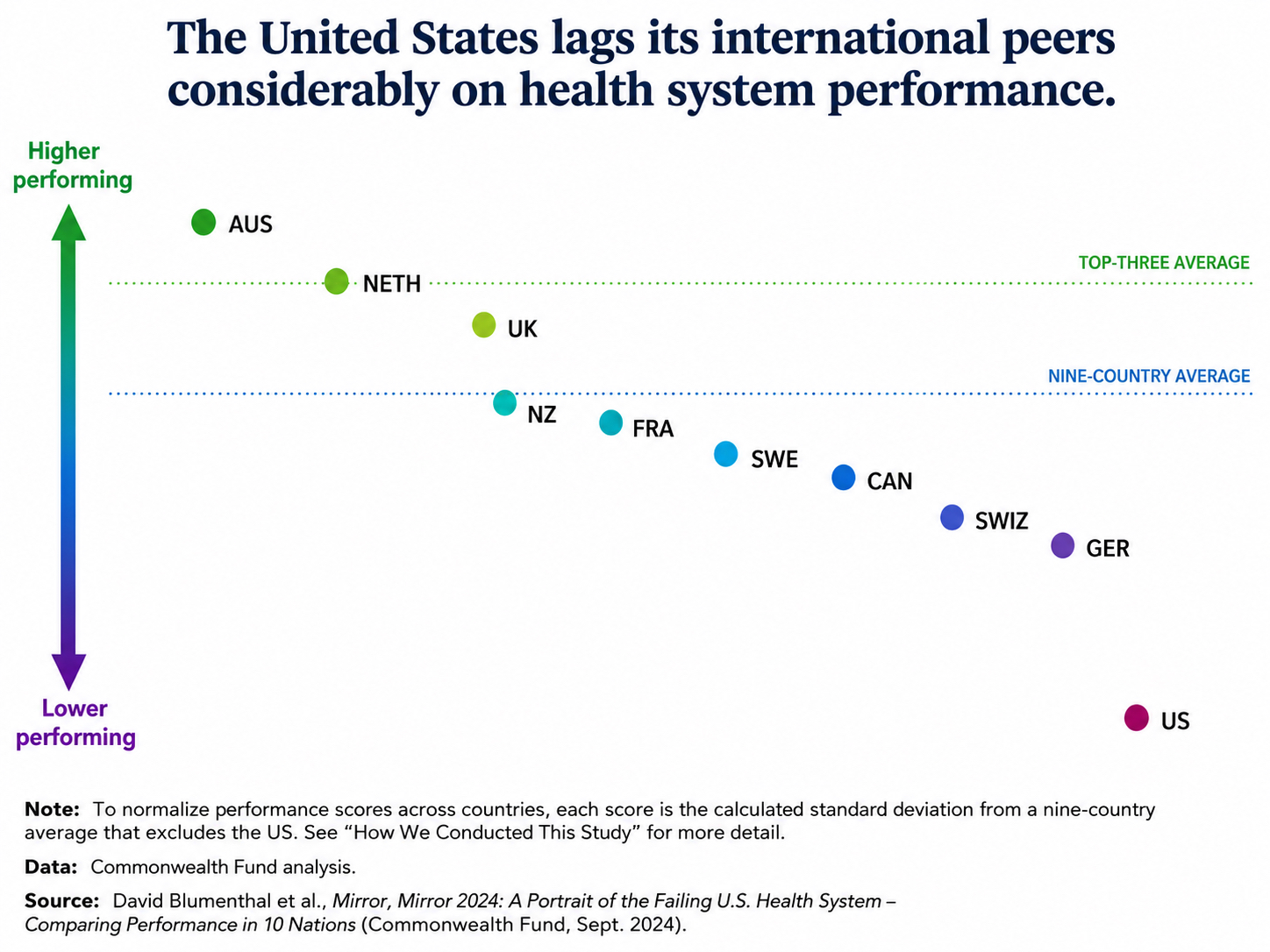
Graphs herein recreated from data published from Commonweath Fund and OECD.
Australia ranked first, followed by the Netherlands and the United Kingdom. The Commonwealth Fund cautions against reading too much into small differences between individual countries because every health system has strengths and weaknesses. But the researchers found something different about the United States: it was the clear overall outlier, with performance dramatically below the other nine countries. (Commonwealth Fund)
That distinction matters.
It would be inaccurate to say that this report proves the United States has “the worst health care system in the world.” It does not.
What we can accurately say is:
Among the 10 high-income nations examined in the Commonwealth Fund’s 2024 study, the United States ranked last in overall health-system performance.
That is still a remarkable finding.
Read the Commonwealth Fund’s Mirror, Mirror 2024 report
But There Is Another Side to the Story
The Commonwealth Fund findings do not mean that American medical care performs poorly in every respect.
In fact, this is one of the most important qualifications in the report.
The United States actually ranked second in the “care process” category, which examines aspects of how clinicians provide care, including preventive care, patient engagement, and coordinated care. No country ranked first or last in every category. (Commonwealth Fund)
That tells us something important.
The problem is not adequately described by saying:
“American doctors aren’t very good.”
Nor can we simply say:
“American hospitals aren’t very good.”
Those conclusions are not supported by this research.
The question is much broader.
It concerns the system through which an entire population obtains, pays for, navigates, and receives health care—and what ultimately happens to the health of that population.
And that is where the American story becomes particularly challenging.
Now Add the Cost
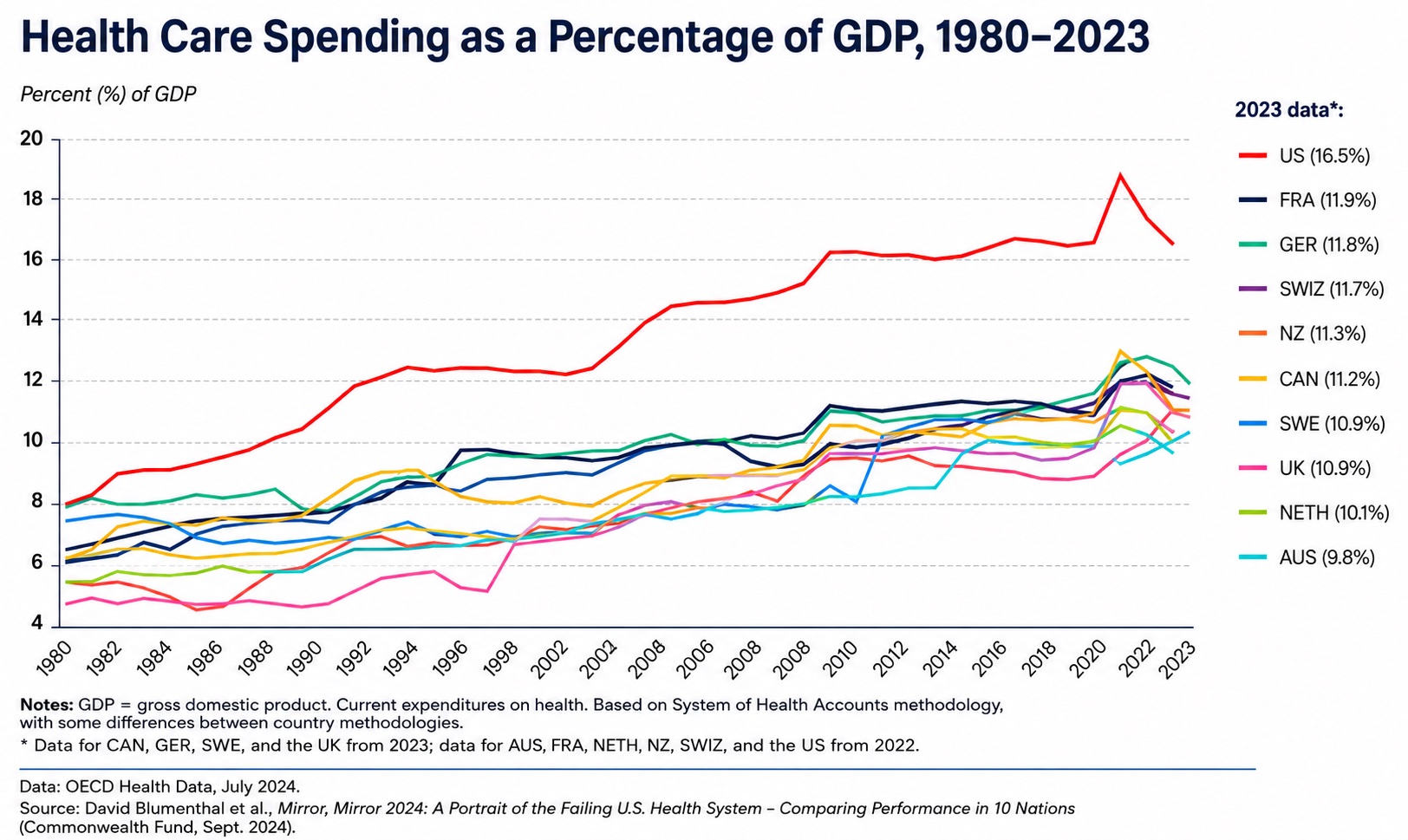
If the United States ranked last but spent substantially less than the other countries, we might understand the tradeoff.
Perhaps poorer performance would simply reflect fewer resources.
But that is not what we find.
The United States spends far more.
The Commonwealth Fund emphasizes that health care spending itself was not included as a performance measure in the Mirror, Mirror ranking. That’s important. The U.S. was not ranked last because it spends too much.
Spending is a separate piece of information.
And when spending is placed beside performance, the contrast becomes striking.
The Commonwealth Fund found that the United States spends a much larger percentage of its economy on health care than the other nations studied, while simultaneously producing the lowest overall system performance. (Commonwealth Fund)
In other words:
We are not getting poor results because we refuse to spend money on health care.
We are spending enormous amounts of money.
That raises a different question:
What are we getting in return?
The OECD Gives Us Another Way to Look at It
This is where a second independent source becomes particularly helpful.
The Organisation for Economic Co-operation and Development, or OECD, collects standardized economic, social, and health statistics from developed countries around the world.
Its Health at a Glance 2025 report allows us to compare U.S. health spending and outcomes against OECD averages.
The numbers are striking.
Health spending per person
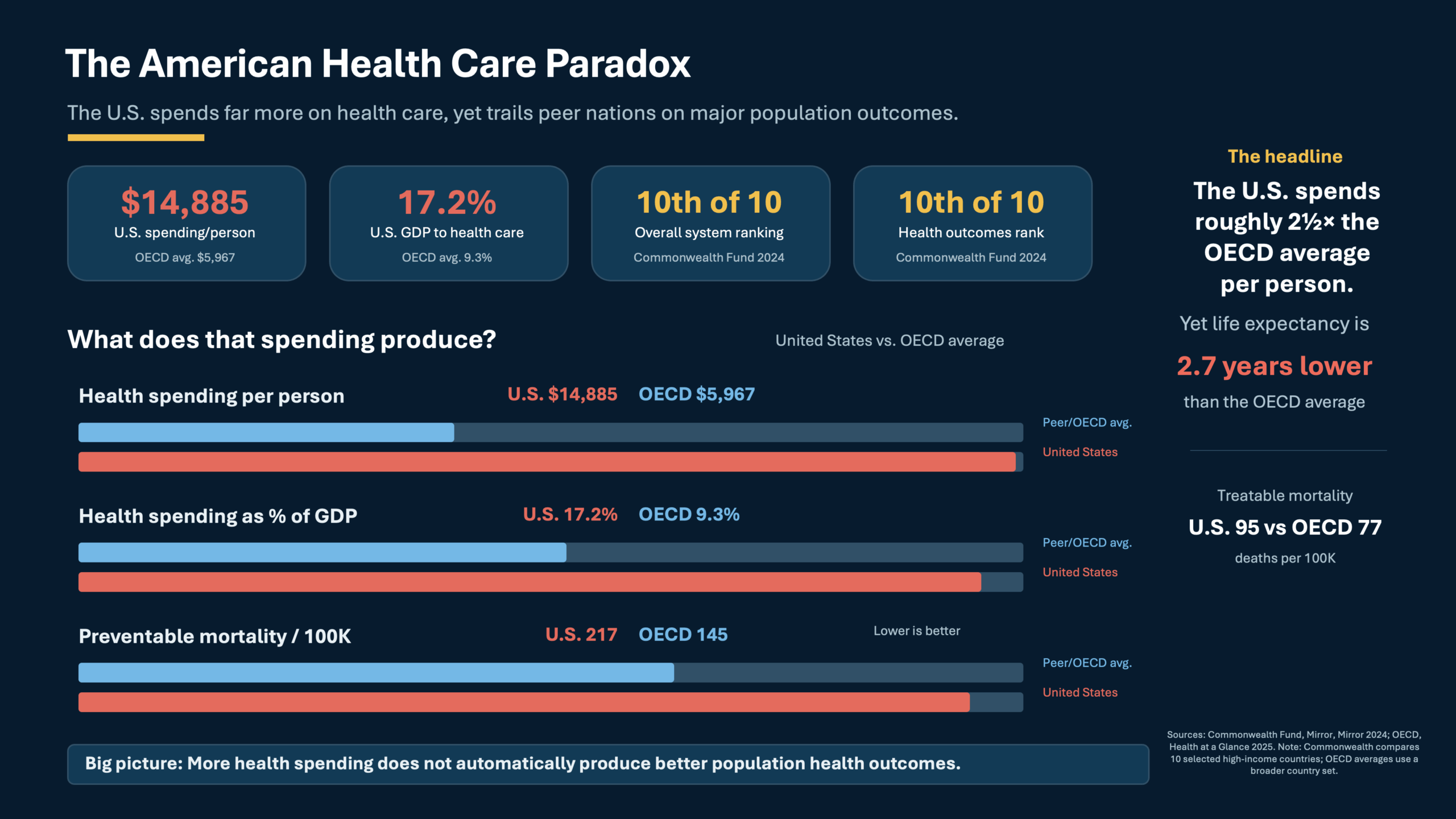
United States: $14,885
OECD average: $5,967
That means U.S. health spending per person is roughly two and a half times the OECD average. (OECD)
Health spending as a share of the economy
United States: 17.2% of GDP
OECD average: 9.3%
Again, the United States is devoting an extraordinary amount of economic resources to health care. (OECD)
If spending alone produced health, we might expect the United States to dominate the international health rankings.
But it doesn’t.
Explore the OECD’s Health at a Glance 2025 U.S. comparison
What Are We Getting for That Money?
Consider life expectancy.
According to the OECD:
United States: 78.4 years
And that is:
2.7 years below the OECD average. (OECD)
Then consider preventable mortality—deaths that potentially could have been avoided through effective public-health measures and prevention.
United States: 217 deaths per 100,000
OECD average: 145 death sper 100,000
Now consider treatable mortality—deaths that potentially could have been avoided through timely and effective health care.
United States: 95 deaths per 100,000
OECD average: 77 per 100,000. (OECD)
These figures begin to reveal why simply measuring how much a country spends on health care can be misleading.
The United States is putting enormous resources into health care.
But spending more money does not automatically mean producing more health.
More Resources in Some Areas—But Not Necessarily Better Outcomes
There is another interesting finding in the OECD report.
The United States actually has more resources than the OECD average on six of ten key indicators measuring health-system resources for which the comparison was made, with one indicator lacking U.S. data. (OECD)
But those resources are not evenly distributed across the system.
For example, the United States has only:
2.7 practicing doctors per 1,000 people
compared with an:
OECD average of 3.9.
At the same time, the United States has:
12.4 practicing nurses per 1,000
compared with:
9.2 across the OECD. (OECD)
So even here, the picture isn’t as simple as saying America has too many or too few medical personnel.
The deeper question is how those resources are organized, financed, distributed, and utililized.
And the Newer Evidence Hasn’t Made the Problem Disappear
In May 2026, the Commonwealth Fund returned to the subject with an expanded report:
U.S. Health Care from a Global Perspective, 2026.
This time researchers compared the United States with 19 other countries across insurance coverage and access, affordability, care delivery, and equity of outcomes. (Commonwealth Fund)
Its conclusion remains sobering.
The Commonwealth Fund reports that the United States has, on average, the poorest health outcomes of any high-income country and among the poorest outcomes of high- and middle-income OECD nations included in its analysis. (Commonwealth Fund)
The report also found that in 2024 the United States devoted 18% of GDP to health care, nearly twice the OECD-country average used in that analysis. U.S. per-person health spending was about 1.5 times that of Switzerland, the next-highest-spending country in the comparison. (Commonwealth Fund)
Meanwhile, the Commonwealth Fund identifies several systemic challenges, including:
- Lack of universal health coverage
- High out-of-pocket costs
- Weak primary-care infrastructure
- A complicated insurance system
- Shortages of primary-care physicians (Commonwealth Fund)
Read U.S. Health Care from a Global Perspective, 2026
We Need to Be Careful About What These Numbers Mean
There is an important caution here.
Health-system performance and population health are not exactly the same thing.
How long people live and how healthy they are depend on much more than doctors, hospitals, and insurance.
Health is also affected by:
- Diet and nutrition
- Physical activity
- Obesity
- Smoking and substance use
- Violence and accidents
- Income and education
- Housing and environment
- Social conditions
- Individual behavior
So it would be overly simplistic to look at America’s lower life expectancy and conclude:
“The medical system caused all of this.”
The evidence does not establish that.
But the opposite conclusion would be equally difficult to defend.
When a country spends substantially more than its peers on health care while continuing to experience poorer outcomes on numerous measures, it is reasonable to ask whether the system is allocating its enormous resources as effectively as it could.
And that may be the most important question raised by these reports.
Perhaps We Should Ask a Different Question
For decades, much of the American health conversation has focused on:
How much are we spending on health care?
Perhaps the more revealing question is:
How much health are we producing from all that health care spending?
Those are not the same thing.
A society can become extraordinarily sophisticated at diagnosing disease, treating disease, managing disease, developing new pharmaceuticals, performing advanced procedures, and keeping seriously ill people alive.
But a high-performing health system must ultimately be evaluated by something more fundamental:
Are people healthier because of it?
The Commonwealth Fund and OECD data suggest that America has considerable room for improvement in turning its extraordinary health care investment into better population outcomes. (Commonwealth Fund)
The American Health Care Paradox
Put the two major findings beside each other:
Commonwealth Fund
Among the 10 wealthy nations studied in Mirror, Mirror 2024, the United States ranked last overall in health-system performance. (Commonwealth Fund)
OECD
The United States spends just short of $15,000 per person on health care compared with an OECD average of nearly $6,000, while the U.S. rating compared to a backdrop of nine other modern wealthy nations places the U.S. last.
That’s the paradox.
Extraordinary spending. Extraordinary medical capabilities. Yet comparatively disappointing population-level results.
That does not diminish the remarkable work performed every day by American physicians, nurses, researchers, hospitals, and other health professionals.
Rather, it raises a larger question about the system in which they are working.
And perhaps that is where a productive conversation should begin.
Starting with this question:
If the United States spends more on health care than any comparable nation, why aren’t we producing better health outcomes?
That question deserves more than a political answer.
It deserves investigation.
Because when it comes to something as important as our health, the objective should not simply be to spend more or even to produce more sophistication.
The objective should ultimately be to understand how we can authentically produce more health.