Click Play to Start
Though it remains true that health-minded shoppers are unlikely to find Acemannan in most health food stores—or even listed as a meaningful ingredient in the vast majority of aloe vera products (click here for more), the term Acemannan is beginning to appear more frequently in online nutritional offerings. In fact, I recently encountered it listed as a minor ingredient in what could best be described as a wellness drink. Here’s a picture of its ingredient list. Ace-mannan is listed here, but join me now as I dig deeper and reach wider.
The concern here is not increased competition because, honestly, this is just more market noise. Greater awareness of Acemannan does not remotely push the best of nutraceutical companies toward obscurity. And this video explains why. What is concerning is something far more important: that Acemannan is increasingly referenced without clarity, distinction, or qualification; in other words limited information—creating a risk that truly high-quality, biologically active Acemannan could be overlooked or dismissed for no valid reason. When all Acemannan is treated as equal or even as a generic additive in a wellness drink, the science that differentiates quality, potency, and immune relevance could be lost to the consumer, and consumers are left unable to discern what actually matters.
This video is my welcoming you to a focus on what really DOES matter concerning Acemannan.
It is an oversimplification to say that Acemannan is Acemannan; aloe products are aloe products—implying there is nothing unique or scientifically meaningful to explore. Some people assume that that way of thinking is sufficient. For instance, vitamin C is often treated as a single, interchangeable ingredient. Yet we know there is a meaningful difference between naturally occurring vitamin C in whole foods and isolated or synthetic forms of vitamin C, particularly in how the body absorbs and utilizes it. The name may be the same, but the form, structure, and context determine the outcome. Acemannan is subject to the same principle.
Let me begin with why all Acemannan is not the same and why what we have is fundamentally different.
The Discovery of Acemannan
Acemannan was discovered in 1985 by a research team at Southwestern Medical School, led by Dr. Bill McAnally, a pharmacologist and toxicologist at Carrington Laboratories.
Industry researchers came to the medical school because something remarkable was happening with fresh aloe vera gel. It was triggering an immune response unlike anything they had seen before.
There was a problem, though.
That activity disappeared within 24 to 48 hours after the leaf was cut away from the aloe plant. The molecule was labile—unstable, and the Acemannan, the active ingredient, would neutralize or deactivate within a day or two.
That led to an important realization:
You can’t patent a naturally occurring molecule, like Acemannan—but you can patent a process that stabilizes it.
So the goal became clear:
Identify the molecule, figure out why it breaks down or neutralizes, stop that process, stabilize it, then consider how to take it to market.
Why They Almost Missed It
The team spent months eliminating proteins, enzymes, and other candidates—because they weren’t even looking at carbohydrates, or what scientists understand as polysaccharides.
At the time, polysaccharides (the carbohydrates) were thought of as nothing more than sugar that converts to energy.
But eventually, they landed on a unique group of polysaccharides, made almost entirely of a sugar called mannose.
This period aligned with the rise of glycobiology as a newly recognized field of science at around 1988. While its discoveries had been accumulating since then, glycobiology did not gain formal recognition in mainstream medical textbooks until the early 2000s.
Glycobiology revealed that sugars—especially mannose—are critical for how proteins are coded and how they function inside the body.
Every protein in your body goes through a coding process, and mannose plays a central role in that process.
Naming Acemannan
When this new Acemannan structure was submitted to the American Chemical Society, it was confirmed that this molecule had never been identified before.
It was formally named:
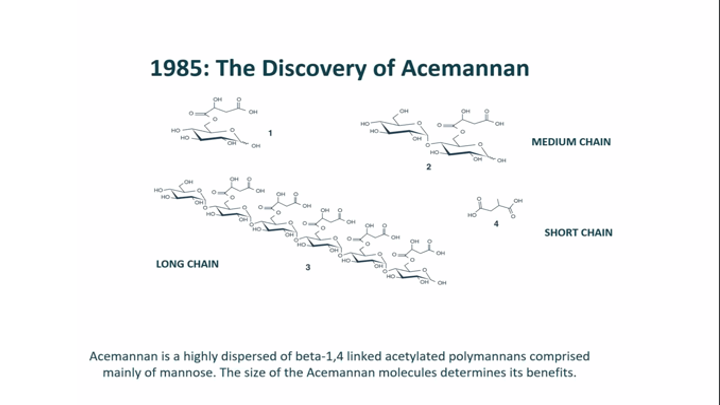
Highly dispersed beta-1,4 acetylated polymannan—mercifully shortened to Acemannan.
That name didn’t come from marketing.
It came from the U.S. Names Council, which is a part of the American Chemical Society.
Why Stabilization Matters
When an aloe leaf is cut from the plant, an enzyme activates and breaks Acemannan down (causing it to neutralize), allowing moisture to evaporate. In the organic order of things, that’s how the plant naturally sheds damaged leaves.
Dr. McAnally’s team identified and deactivated that enzyme.
For the first time, Acemannan then was stabilized.
That breakthrough eventually led to multiple patents. Here are two of those patents. Notice two names at the bottom that you hear me talk about often: Dr. Bill H. McAnalley and Dr. Santiago Rodriguez.
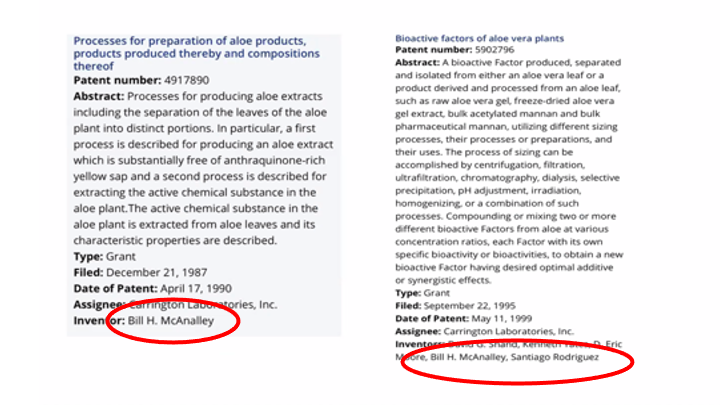
Carrington Labs was so excited about this discovery and its bioactivity that they believed Acemannan could become a drug—specifically an immunotherapeutic, not something that suppresses symptoms, but something that optimizes immune function.
They also filed a Use Patent showing Acemannan’s ability to stimulate immune activity. The very first sentence says,
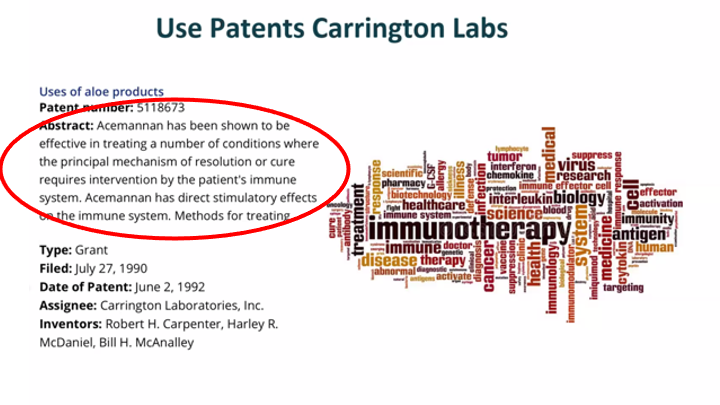
“Acemannan has been shown to be effective in treating a number of conditions where the principle mechanism of resolution or cure requires intervention by the patient’s immune system.” This statement sounds scientifically interesting but the implications are anything but benign. We know this from gaining an answer to one simple question, “What conditions would that be that need the immune system for proper recovery and resolution? Answer. Every single one of them. There is no poor health condition that does not need the immune system for proper recovery. And before this video is complete you’ll understand why the right kind of Acemannan is a modulating and stimulating force to that end.
But in 1993, the FDA rejected their drug application.
Not because Acemannan was dangerous—but because it wasn’t dangerous; it wasn’t toxic. It failed the LD50 rating and the LD100 rating. As Sam Caster, who has been on board with Acemannan since 1993 and worked closely with its scientists, pointed out,
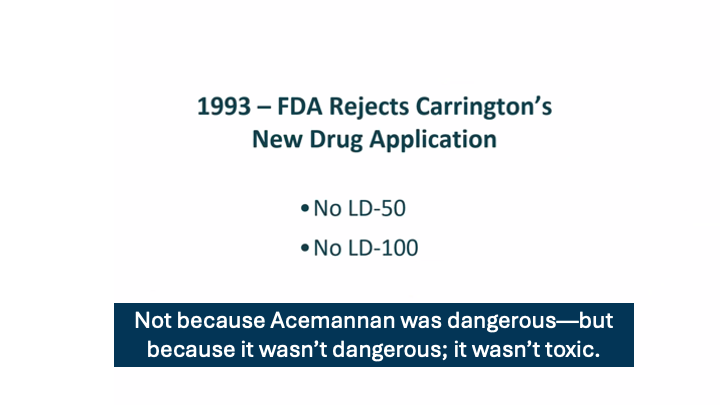
“LD refers to lethal dose. In drug testing, researchers must show an LD50—the dose that kills 50% of test animals—and an LD100—the dose that kills all of them, with a safe margin between the two for human use. No matter how much Acemannan was tested, no lethal dose could be established. While that seemed like a breakthrough, in this case FDA drug approval required demonstrable toxicity. Because Acemannan showed none, the FDA rejected the investigative new drug application.”
But not all was lost. Maybe they didn’t have a drug according to FDA standards; but for sure they had a nutrient.
At this point Carrington was on their way to spending $100 million in research and they needed revenue to continue the research, so they entered the dietary supplement market.
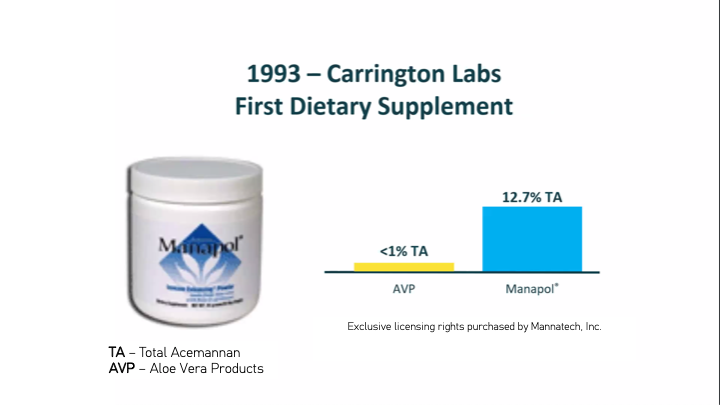
Dr. Santiago Rodriguez, an organic chemist and Acemannan processing expert, and who also worked with Carrington Labs, developed the first stabilized Acemannan supplement called Manipol®.
Manipol® contained 12.7% Acemannan per gram of aloe extract—while most aloe products contained effectively zero.
This is where Sam Caster entered the picture and took it to market, licensing Manipol® exclusively for nutritional use.
The Mystery of “Advanced”
And everything was going really well with a national and international market reach. They would soon make some corporate decisions to formulate an alternative stabilized Acemannan in an attempt to reduce costs. They called it Advanced. It tested nearly identical in total Acemannan content at 12.1%
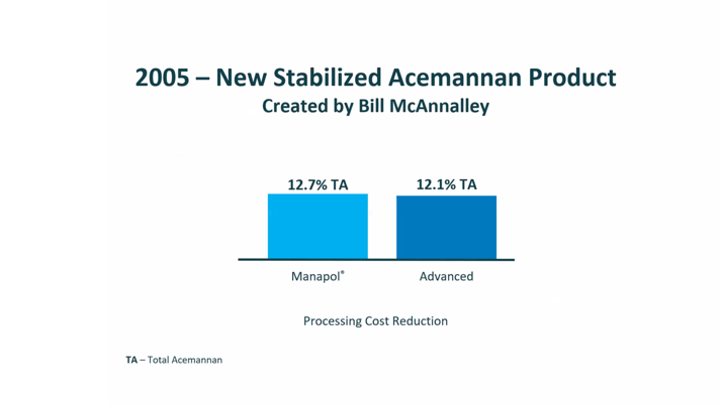
On paper, it looked equivalent.
But something strange happened.
Consumers reported that symptoms returned when they switched to Advanced—then symptoms disappeared when they switched back to Manipol®.
At the time, no one could explain why. The corporate leaders and the scientists mutually went into a head-scratching mode. What could be the problem?
They had rolled out what appeared to be an equivalent Acemannan product, and yet people were telling them, “Something’s missing.” At the time, they didn’t have an answer.
What they didn’t realize is that the answer had already appeared—that same year—but almost no one was paying attention.
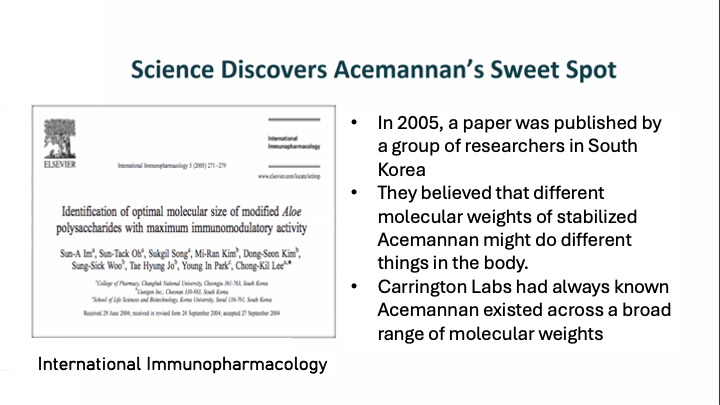
In 2005, a paper was published in International Immunopharmacology by a group of researchers in South Korea. Their premise was simple but profound: they believed that different molecular weights of stabilized Acemannan might do different things in the body.
Carrington Labs had always known Acemannan existed across a broad range of molecular weights, as you can see in this graphic. Short chains, medium chains, and long chains of these mannose molecules linked together. But no one had mapped which sizes mattered most.
So the South Korean researchers asked the key question:
If Acemannan optimizes immune function through macrophage activation, are all molecular weights equally effective at doing so—or is there a sweet spot? In other words, is there a particular molecular weight that delivers the strongest, most reliable immune response? This question was clear in the title of the study: Identification of optimal molecular size of modified Aloe polysaccharides with maximum immunomodulatory activity.
They broke it down and found the answer.
Their conclusion was clear:
Aloe polysaccharides between 50,000 and 400,000 daltons (daltons is a unit of measurement in molecular science) showed the strongest immune-activating activity. This would be the medium chains.
Below that range, or above it, immune response dropped off significantly.
Almost no one noticed this—except Dr. Santiago Rodriguez, whose life’s work focused on Acemannan processing.
Dr. Rodriguez went back and analyzed aloe products across the industry. What he found was startling: most had little to no Acemannan at all; this is the same conclusion Dr. Bill McAnnaley came to in his book The Science of Aloe. And additionally Dr. Rodriguez concluded that there was also no immune-optimizing fractions in that critical molecular range.
Then he looked at Manipol®—the Acemannan he himself had helped produce.
About one-third of Manipol® (around 4%) fell within the immune-optimizing range. That’s why, at recommended doses, people experienced meaningful results.
For the first time, they now knew which fraction mattered most for immune optimization—the very function everyone cared about the most.
When Dr. Rodriguez analyzed the “Advanced” formula, the mystery was finally solved.
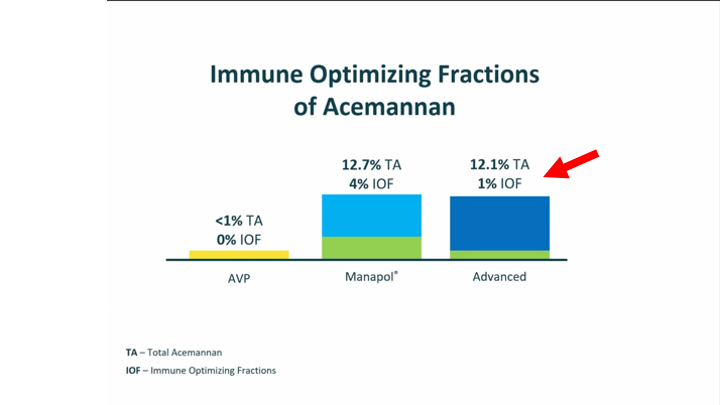
Only 1% of its composition fell into the immune-optimizing range—this meant four times the recommended dosage would have to be consumed to get the same levels as Manipol®, the first generation of Acemannan.
But at the same dosage. It would be a different biological impact. Therefore a different outcome. That’s why people noticed the difference.
Biological impact depends not on total Acemannan, but on the presence of the right molecular fractions therein. This is vital.
Here’s what’s fascinating:
The longer chains—outside the immune range—weren’t useless. They were being fermented in the gut, acting as super glycofibers, producing beneficial bacteria and short-chain fatty acids—far more effectively than common fibers like inulin.
And the shortest chains?
Those could be absorbed directly into the bloodstream through mannose pump sites in the intestinal wall—feeding glycoprotein synthesis at the cellular level.
So the shortest chains and the longest chains had their place. There was nothing wasted.
For instance: Two protein drinks may list the same grams of protein, but one contains a complete amino acid profile while the other does not. You could consume more of the inferior product, but the biological outcome would still fall short.
Acemannan works the same way. Total quantity per gram of aloe extract isn’t always the main objective. The immune response depends on the presence of the right molecular fractions.
Scientists use the word “fractions” quite a bit but understand it simply as each of the components found inside the aloe plant (including Acemannan) are a fraction (a small portion or segment) of the plant as a whole.
And this leads to a bigger realization:
There is an enormous difference between typical aloe products and what we bring to the market. Roughly 99% of commercial aloe products contain zero immune-optimizing Acemannan fractions, even if the label mentions Acemannan.
So if someone says, Yeah, I take a product that lists Acemannan as an ingredient, be sure and tell them about this video.
But I’m not done yet…are you with me?
Shouldn’t we assure that our body of knowledge is not just so much white noise—a constant hum that keeps us from hearing the hard truth that actually matters and prevents us from obtaining the education needed to make informed decisions?
If claims are made or the simple inclusion of Acemannan in a nutritional product easily satisfies consumers with no interest in making further inquiry, perhaps the next step is: “Show them the Certificate of Analysis.”
Here is a copy of one of ours.
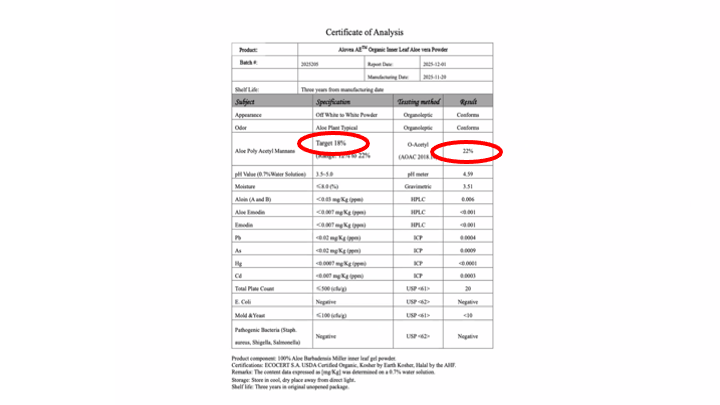
We do not market anything that is less than 18% immune activating fractions. But as you see this one reflects 22%. I picked this up from a presentation given by Sam Caster, and clarified it further with our Product Formulator, Steve Burns.
The Certificate of Analysis is a significant way we prove the claims, as an expanded part of the science that undergirds our market impact.
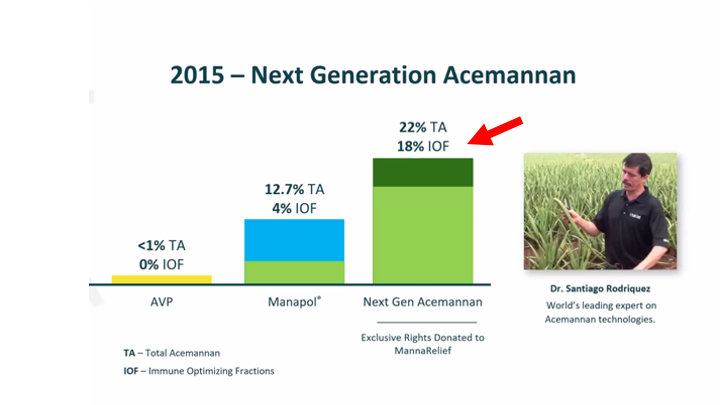
With this new understanding, Dr. Rodriguez recognized an opportunity. He then created the second generation of Acemannan, using everything science had now revealed.
Instead of patenting it, he protected it as a trade secret (I talk about this at this link)—and donated exclusive rights to Manna Relief, aligning it with a mission-driven, buy-one-nourish-one model.
This new Acemannan contains at least 22% total Acemannan (TA) per gram of aloe extract, with at least 18% in immune-optimizing fractions (IOF)—four to five times more immune-active Acemannan per gram than anything that came before.
How do we prove it? With facts. With science.
With certificates of analysis, showing exactly what we produce. We welcome any producers and manufacturers to show us their Certificate of Analysis so we can compare.
Both our marketing and our mission rise above the noise to deliver evidence-based understanding and real-world impact.
And that’s why what we have is not only unique and proprietary—but our Acemannan empowers the contribution we make to saving lives, especially where malnourishment persists among some of the most medically fragile children of the world through our buy-one-nourish-one Social Business 3.0 platform.
I hope you will always be careful to maintain good works to meet urgent needs and become heroes to your generation.
0 Comments